As I write these lines, the death toll from the Ebola virus is mounting in Guinea. The Centers for Disease Control and Prevention in Atlanta (known by the initials CDC) count 157 cases and 101 deaths, 66 of them confirmed cases.
The epidemic has also hit Liberia (22 cases, four deaths and five laboratory-confirmed cases). But the Guinean outbreak is undoubtedly one of the most serious.
This is not the first time Ebola has emerged from its hiding place in the jungle to attack human beings. In 1976 the virus spread terror in Yambuku, in what was then Zaire (today the Democratic Republic of the Congo), killing 280 of the 318 people it infected.
We tend to shudder at the mere mention of this virus precisely because of its lethality – close to ninety percent depending on the outbreak – and above all because of the popularity of the descriptions by writer Richard Preston in his book The Hot Zone (published in Spanish by Emecé). The hemorrhagic fevers and bloody vomiting of the infected turned them into a kind of zombie, whose bloodshot eyes dissolved before our very eyes. Is it true?
Virologists who have faced Ebola, such as Daniel Bausch, admit that the disease and the damage the virus does to the body are terrible, but a far cry from Preston's cinematic descriptions.
Viruses are the favorite device and the perfect pretext for portraying the collapse of modern society on the big screen.
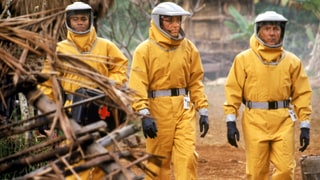
They make superb messengers of the Apocalypse. There is a long list of good films, some of them notable box-office hits, that would have no reason to exist if viruses had not escaped from the test tube to wreak havoc.
To what extent does this kind of cinema exaggerate and distort reality?
In Resident Evil and the other films in this successful franchise, a lab-made virus ends up turning the researchers of a company, Umbrella, into zombies, the company's control being initially in the hands of an artificial intelligence.
It is not a brilliant plot. It is riddled with clichés, but it gives the screenwriters plenty of settings in which to shoot great action scenes. And it certainly made a star of the stunning Milla Jovovich in this kind of film.
At the start of the remake of I Am Legend, starring Will Smith, we witness an extraordinary announcement by a doctor played by Emma Thompson, who declares before the cameras that she has found a cure for cancer.
In this case, patients were infected with a genetically modified virus designed to destroy tumors. But the virus escapes human control and infects the rest of humanity, turning the survivors into a rather strange kind of zombie.

Will Smith is the only one who seems immune to the virus. Just like Charlton Heston in The Omega Man, although there it is not specifically a virus but a microorganism used in biological warfare.
In the series The Walking Dead, we find a far more elaborate and equally fascinating explanation involving viruses. We are shown footage taken from a brain scan of a person who has been bitten by a zombie and who “comes back to life” some time later.
The bite transmits a kind of virus similar to rabies. The virus disables the higher part of the brain, the cortex, where memories and personality are stored, and when the brain shuts down, death follows.
And shortly afterwards we discover that the virus activates the cerebellum, which controls the body's basic, automatic functions. The resurrected person becomes a shell of what they once were, ruled solely by instinct.

28 Days Later and its sequel, 28 Weeks Later, tell of the transmission of a virus that drives chimpanzees mad and jumps to humans. That virus, as it could hardly fail to, has the property of turning human beings into zombies. The Apocalypse is served.
There are films built on plots about what could happen because of a virus that are a good deal less fanciful. Readers of Planeta Prohibido know our comments on Contagion, in which Steven Soderbergh spares no one in describing how politicians, health authorities, the military, the press and ordinary people react to a flu pandemic with a 30 percent mortality rate.
And before that, in Outbreak, led by Dustin Hoffman, we are told what might happen if the Ebola virus – here called Motaba – spread through the air, like a flu with one hundred percent mortality. A small American town is cut off from the rest of the country. The military plans to destroy the town to prevent a pandemic...
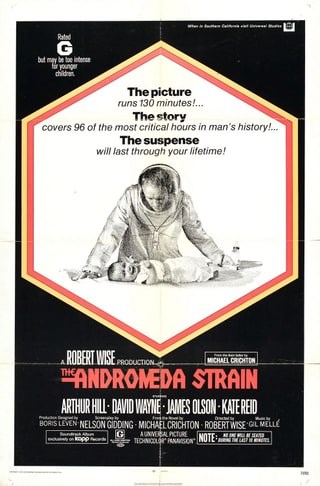
But without doubt the best and most realistic film of all about potentially lethal infectious microorganisms is The Andromeda Strain, directed by the master Robert Wise and based on the novel by Michael Crichton. It is a masterpiece, highly recommended, and it remains entirely believable. We witness a concert of scientific explanations, pH values, robots, computers and high-tech laboratories that even today do not look dated, although the film was shot in the early seventies.
Screenwriters' plots do not have to be scientifically accurate or correct. They have to be believable, and that depends on whether or not the audience will accept the story. Scientific credibility is one thing, and cinematic credibility quite another. They do not necessarily have to coincide.
But the fact is that most works about viruses assume that at some point a lethal microorganism will emerge capable of wiping out seven billion human beings, leaving not a single one (except the protagonists who have not yet been infected), and this, biologically speaking, makes no sense.
It makes no sense because a virus that is too lethal cannot spread quickly, as is the case with Ebola, which requires direct contact between the infected person and a healthy one. By killing quickly, it reduces the chances of immediate contagion.
When the virus breaks out in an African village, it arrives with a man or woman who falls ill and needs care from their relatives, who in turn fall prey to Ebola. Within a few weeks, families die in their homes and the outbreak eventually burns itself out. In hospitals and urban settings, however, Ebola does have a better chance of spreading.

What if it underwent some kind of mutation that allowed it to spread through the air? Experts do not rule out this possibility, but that change would come at a price, paid in the microorganism's aggressiveness. In exchange, it would infect many more people. And that is something that, in evolutionary terms, is “in the interest” of the virus.
Take the AIDS virus, HIV. When it jumped to human populations, it was a fairly virulent virus, but it could take months or even years to kill its victims. That gave it the time it needed to infect as many people as possible.
The AIDS pandemic grew precisely because infected people suffered no immediate symptoms. Sometimes the virus took years to multiply enough to destroy the body's defenses. And meanwhile it could jump invisibly from one human being to another, without leaving any symptoms or raising the alarm.
It is a terrible strategy, but this virus has not managed to wipe out the human species. In my opinion, such an event is more likely to happen if we are hit by a meteorite one or several kilometers across. But fortunately, that kind of event is so rare that it happens only once every hundreds of millions of years.