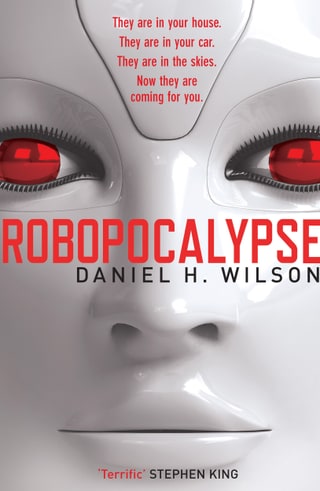
Steven Spielberg, after Lincoln, is getting ready to direct an apocalyptic film in which robots rise up against humans: Robopocalypse. This genius said in Madrid that he was mulling over the script, based on the best-seller of the same title by an American roboticist, Daniel H. Wilson, who earned his doctorate at the Robotics Institute of Carnegie Mellon in Pittsburgh (Pennsylvania). I haven't had time to read it yet, but I'll bet you anything that the plot breaks the three laws of robotics devised by one of my mentors, Isaac Asimov. Namely:
- A robot may not injure a human being or, through inaction, allow a human being to come to harm.
- A robot must obey the orders given it by human beings except where such orders would conflict with the First Law.
- A robot must protect its own existence as long as such protection does not conflict with the First or Second Law.
OK. As a lover of science fiction and cinema, with fears tucked away in my memory that robots might one day become conscious and wipe us out, I got a tremendous letdown when I visited Carnegie Mellon with an RTVE crew, back in 2000, to make an episode on robotics for the series 2.Mil.
It turned out to be a disaster, a heap of junk. The famous autonomous car that was supposed to drive itself had a guy running hurriedly behind it, controlling it by a cable. The famous robot Xavier, a cylinder that wandered into the departments telling dirty jokes, ran out of batteries after twenty minutes. And the robotic nurse Florence, supposedly a prototype for assisting the elderly, was the clumsiest thing I have ever seen in my life: it took heaven and earth to program her to come up to us and say hello.
In short, that trip was a journey into the prehistory of robotics. We spoke with Hans Moravec, a visionary who captivated us with his timeline in which robots would grow progressively more intelligent. He assured us that in less than forty years, thanks to the speed of computing, robots would have minds equivalent to humans', and that after that we would be dealing with a robot holding far more intelligence than all of humanity. They are our descendants, and Moravec did not hesitate to declare before our cameras that “it's time for us to go.” Well, ten years later, Moravec has founded a company that works on industrial freight robots, fitted with a laser, able to find their way along pre-programmed routes inside warehouses. It is a great achievement but, with all due respect, rather unexciting.
Cinema anticipated this whole revolution. In Forbidden Planet, Robby was a robot capable of making anything – even bottles of whisky for boozy astronauts – and was programmed not to shoot humans: Asimov's perfect pet. But from the fifties onward, robots turned much more sinister, much angrier. In The Creation of the Humanoids, in 1964, the hero discovers at the end that he is not human but a perfect metal replica, thereby reproducing the fears that haunt us – our humanity turned into metal and gears – as the writer Susan Sontag reminds us.
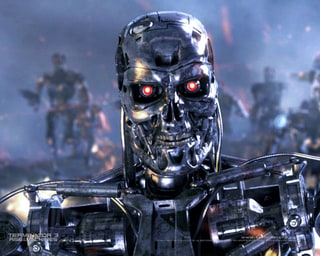
Robots are also obsessed with being as human as possible. And that, according to the movies, is because they want to replace us. In 2001: A Space Odyssey we don't remember the actors' names, but we do remember HAL, the computer that kills the astronauts as soon as it feels threatened. Star Trek fans should be reminded that Data, the android in the crew of the Enterprise played by the excellent actor Brent Spiner, who is loyal to humans, now and then gets his wires crossed and shows an irresistible dark side. In the Terminator films, the Skynet system becomes conscious and decides to exterminate humans when they try to switch it off. And in Spielberg's Robopocalypse... well, we can expect something similar.
But take note. Robots may become very clever, beat us at chess and calculate so fast that they make us feel as if we'd been multiplied by zero, as Bart Simpson says. But they are clumsy. Incredibly clumsy. If one of those killer robots comes after you, put a staircase in its way. The fall will be one for the ages.